
 Russel Wicka, a guest writer on Talking WILD, is a Supervisory Forest Technician for the Tongass National Forest, Yakutat Ranger District. This article was published in the Winter 2009 Alaska Region SourDough Notes.
Russia’s Kamchatka peninsula is home to some of the world’s most unique natural territories. Due to its remoteness and strategic military importance, Kamchatka remained relatively protected throughout history. The peninsula has only recently opened up to visitors and become more accessible. This fact, together with economic difficulties facing Russia, has created some challenges for biodiversity and protected areas (PAs) on Kamchatka.
It is expected that visitor use of Kamchatka parks will steadily increase over the coming years. For this reason, managers are seeking increased access to information and strategies for conserving these important resources. This presents a unique opportunity for U.S. Forest Service’s International Programs. Forest Service employees can share valuable experience to help build this capacity in Kamchatka. For example, proper trail construction and maintenance on Kamchatka will become increasingly important. Trails provide access to significant features in protected areas. If the system of trails in a park is poorly constructed, users will actually be damaging the environment they have traveled to visit and witness. It is up to the Regional Park staff to take responsibility over the system of trails in their parks.
In February 2007, the Forest Service joined the Consortium for International Protected Area Management, the Wild Salmon Center, the United Nations Development Program, and Ecocenter Zapovedniks (Zapovednik = Russian for Wilderness) to develop a training program for PA managers. The goal was to create and support a long-term, sustainable capacity building program on Kamchatka that is based on best practices and methodologies. Much of the PA infrastructure, including trail networks, is in poor shape. Game trails adopted into these systems and utilized by visitors are not sustainable. Increasing use of improperly located and constructed trails has lead to resource damage. Through best management practices, Park staff will be able to decrease resource damage by rehabilitating poorly constructed trails and to provide new trails designed for long term sustainability. Properly constructed trails also increase visitor satisfaction.
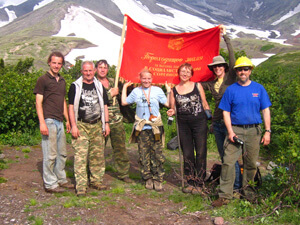
In July 2008, I joined Theresa Spang from the Consortium at a training workshop at Nalychevo Nature Park. Theresa talked about trail planning & design, construction practices, water and drainage issues, and monitoring after construction. I presented the practical hands-on training centered on actual lay-out and construction of a trail in Nalychevo Park. There were 13 participants from three parks: Nalychevo, Bystrinsky and Yuzhno-Kachatsky. There was also a member of the Wildlife Protection Service and two volunteers from the Manfred-Hermsen Foundation. The objectives of the workshop were to:
- Provide theoretical training which outlines all aspects of trail construction from planning and design through final trail construction and post construction monitoring.
- Lead a “hands-on” trail construction project, which highlights all aspects of the theoretical training including the demonstration of several trail rehabilitation and restoration techniques and providing a sustainable trail alignment.
After the classroom presentations, we were led by Park staff to several trails which were becoming entrenched and difficult to hike due to the natural grade of the drainage, which was upwards of 50% in some areas. One old trail went straight down hill; such trails become entrenched when traffic dislocates soil down steep grades. I determined the only way to prevent further resource damage was to relocate the trail to a different site at a sustainable grade. We decided that the entire walking surface would be on native material, and that no excavated soil would be used for the tread. This is a labor intensive form of construction, and a real challenge for a green crew. Field participants were highly motivated, however, and very productive. The novice crew of volunteers, family members and a few park staff produced a high quality, sustainable trai
We also rehabilitated some existing trails. This included decompacting an old trail with a pick and shovel and planting vegetative plugs to reestablish ground cover. Plugs were collected from the general location around the old trail. Care was taken not to make the collection locations visible from the new trail alignment, and not to over harvest any given area of its native plant cover. Also, several sections of old trail were re-contoured to prevailing grade, meaning that the entrenched portions were filled in to the original prevailing grade. A single, well-defined sustainable route was constructed to mitigate the impact of the multiple routes through the area that had been developing. Park staff also posted several informational signs requesting the public to utilize the new routes developed and discontinue hiking on the old trails.
There were numerous challenges associated with this project including lack of funds, proper tools, a short season when work can be completed, and difficult access to trail locations. The true measure of success of this training, however, will be shown by the ability of regional park staff in Kamchatka to recognize resource damage associated with certain trails in their Parks and take action to alleviate these problems. Thanks to the training opportunities we provided, participants learned trail restoration and rehabilitation techniques. Multiple sections of poorly constructed trail were rehabilitated, and in time, will once again function as part of the surrounding dynamic environment. Park staff completed high quality work and addressed watershed damage by correctly locating and constructing trails. They demonstrated safe and efficient use of a variety of tools and surveying equipment.
Park Staff from all the PAs proved to be dedicated, friendly and hard working. These Russian professionals are making major advances in best management practices based on International standards. It was a unique opportunity to see such amazing parks and work with our neighbors just across the North Pacific.